Every importer of fresh fruit has opened a container and not liked what it saw. Soft fruit, decay, uneven colour, the wrong size in the boxes. What happens in the next few hours decides whether the problem becomes a fair price adjustment, a long argument or a lost customer. This guide covers the rules that apply in the European Union, how claims work in practice and what buyers and sellers of Brazilian fruit can agree in advance so that a dispute, if it comes, is short.
Since 2025 the EU rules on fruit and vegetable quality sit in two regulations: Delegated Regulation (EU) 2023/2429 sets the marketing standards, and Implementing Regulation (EU) 2023/2430 sets the rules for checking conformity. Together they replaced the old Regulations 543/2011 and 1333/2011.
Two levels of standard apply. Specific marketing standards cover apples, citrus fruit, kiwifruit, peaches and nectarines, pears, strawberries, sweet peppers, table grapes, tomatoes, lettuces and endives, and bananas. Every other product falls under the general marketing standard. For Brazilian exports this means that limes and table grapes are checked against specific standards, while mangoes, avocados, melons and ginger fall under the general standard. Where no specific EU standard exists, a product is considered to meet the general standard when the holder can show that it conforms to the applicable UNECE standard. In practice, the UNECE standards for mango, avocado or watermelon are the reference for classes, defects, sizing and tolerances.
The public standard is only the floor. Retailers and importers usually buy against their own specifications, which are stricter than Class I. A claim is judged against what the contract says, so the specification must be written into it.
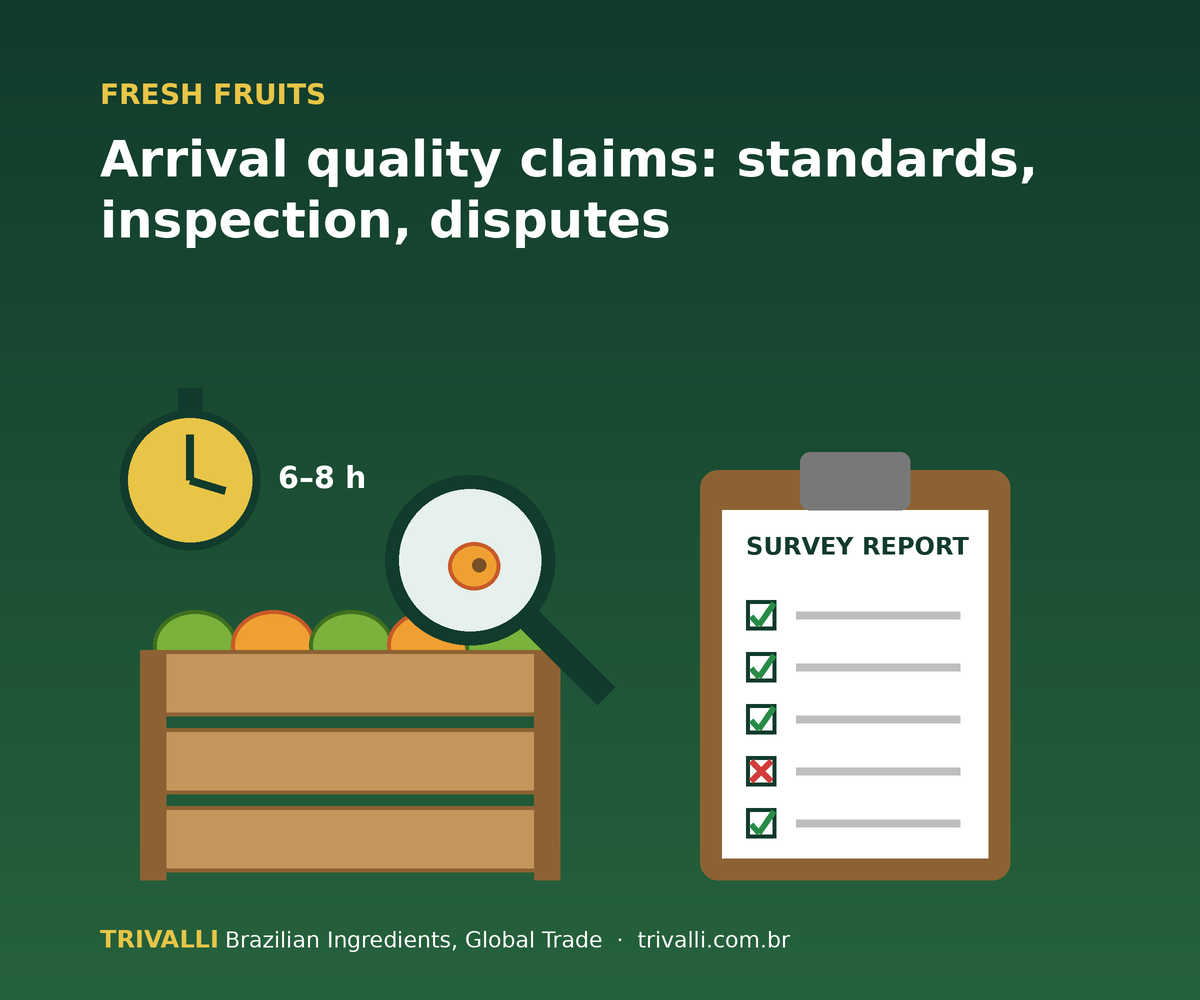
Fresh fruit claims are a race against time. The most widely used trade code in Europe, COFREUROP, sets very short deadlines. Under its 2024 version, complaints about highly perishable goods must be made within six hours of the goods being made available, and within eight hours for other perishable goods. Defects found during unloading must be reported immediately and unloading suspended. Hidden defects, such as pesticide residues, must be reported as soon as they are discovered. A phone complaint must be confirmed in writing at once.
The written complaint should identify the shipment, describe the defects in detail and show that the goods inspected are the goods delivered. Photos help, but they rarely settle a dispute on their own.
Many arrival problems are not the seller's fault. Under CFR or CIF terms, risk passes to the buyer when the goods are loaded on the vessel. If the fruit was sound at loading and deteriorated because the container ran at the wrong temperature, the claim lies against the carrier or the cargo insurer, not the seller. COFREUROP puts it another way: the goods must arrive in the agreed condition after appropriate transport.
The distinction matters for timing too. Claims against ocean carriers are subject to a time bar, generally 12 months after delivery, and carriers often let claims run to that limit. A joint survey with the shipping line's representative, called as soon as the problem appears, keeps that route open.
A Dutch court decision from May 2025 shows what happens when inspection and contract are left loose. A Dutch buyer purchased clementines from a Spanish supplier on EXW terms. An inspection in the Netherlands noted that the colour was only fair, but the buyer continued the shipment after a phone assurance that the fruit would colour in transit. The Norwegian customer rejected it. The court held that under EXW the seller's obligation ended when the goods were made available, the complaint had not been raised in a reasonable time, and a phone assurance did not create a contractual obligation. The buyer had to pay the full invoice, interest and costs.
Under COFREUROP a justified claim allows a price reduction, rescission of the contract or compensation, depending on the case. A reduction is measured as the difference between the contract value and the actual value of the goods delivered. Rescission is limited to cases where losses exceed set thresholds, and the buyer must ask the seller for instructions and protect the goods in the meantime. If no instructions arrive in time, the buyer sells the goods as best it can. Disputes under COFREUROP go to the International Arbitration Chamber for Fruit and Vegetables, whose decisions are final and confidential.
Trivalli Comércio Global is a Brazilian exporter that can supply Tahiti limes, mangoes, Hass avocados, table grapes and fresh ginger to European importers. We agree specifications, inspection points and claim procedures in writing before shipment, so that both sides know how quality will be judged on arrival. If you would like to discuss a programme, please contact us through www.trivalli.com. This article is general information and not legal advice.