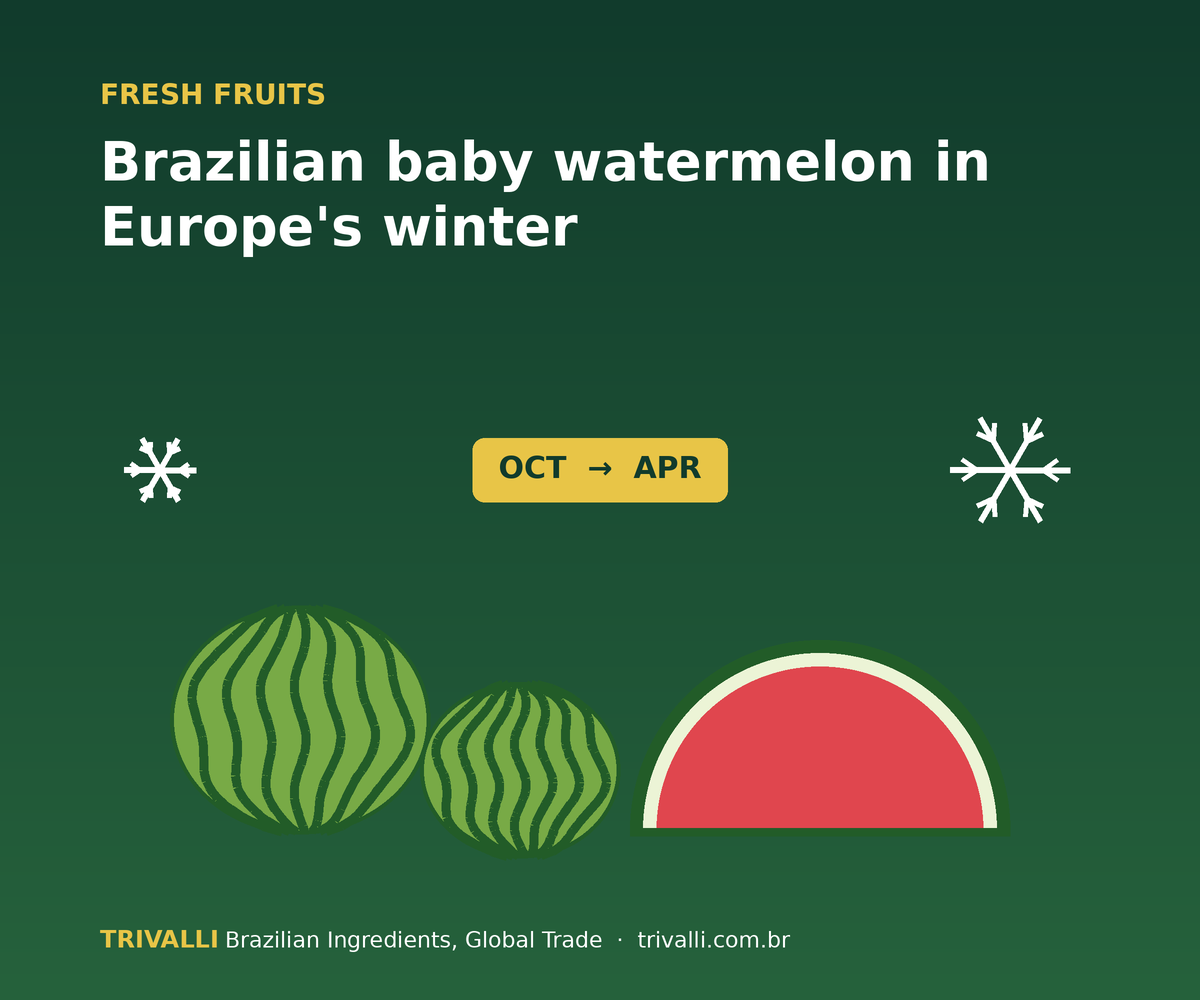
Watermelon is a summer fruit in Europe, but it no longer disappears from the shelves in winter. From October to April, European production is out of season and supermarkets in the north of the continent increasingly stock seedless mini watermelons from Brazil. For importers and retailers, the category has become a programme in its own right, with its own varieties, sizes and logistics. This article sets out the supply window, what the product looks like, and what to specify before committing to a winter programme.
European watermelon production is concentrated in Spain, Italy and France and peaks in summer. Outside that season, roughly from October to April, Europe relies on imports, even though it produces around 3 million tonnes a year. In Brazil the harvest for export runs approximately from August to March, which matches the European gap almost exactly.
The export base is the Chapada do Apodi, on the border between Rio Grande do Norte and Ceará, the same region that supplies most of Europe's winter melons. Shipments leave mainly through the ports of Natal and Pecém. The Port of Natal expects to ship 250,000 tonnes of fruit in the 2026/27 season, and the port authority says it handles about 70% of the melons and watermelons the state sends to Europe and the United Kingdom.
The 2026/27 season is under way. Comex Stat data reported by FreshPlaza show that watermelon exports from the Chapada do Apodi exceeded 22,000 tonnes in September 2026, three times August's volume, but 26% less than a year earlier. The fall was attributed to greater international supply and lower prices in Europe. Buyers will remember the 2025/26 season, when supply in Europe regularly exceeded demand and growers and importers concluded that volumes must be better aligned with real sales.
The growth is in seedless mini and midi watermelons. Smaller seedless fruit sells best to consumers in northern Europe, while ethnic markets still ask for seeded watermelons. In Brazil, about 5,000 of the country's roughly 110,000 hectares of watermelon are dedicated to export-oriented special varieties, mainly for the European Union. Watermelon was Brazil's fastest-growing major export fruit in 2025, with volume up 39.9%, and exporters are aiming to increase volumes up to fivefold by 2030.
Breeders' catalogues give an idea of the sizes on offer. Hazera, for example, lists mini seedless varieties grown in Brazil for winter supply, with fruit averaging about 2.6 kg (6 to 8 per box) for one variety and 1.2 to 2 kg (9 to 10 per box) for another. Retail chains such as Lidl, Carrefour, Auchan and Aldi have sold Brazilian seedless baby watermelons in winter at around EUR 1.60 to 2.00 per kg.
Watermelon is not a difficult fruit to ship, but it is easy to damage through the wrong settings. Two points matter most:
The main entry points for Brazilian watermelons are the Netherlands, the United Kingdom, Spain and Germany, from where the fruit is redistributed across Europe.
There is no specific EU marketing standard for watermelons: they must comply with the EU general marketing standard. In practice, buyers and sellers use the UNECE standard FFV-37 and the OECD interpretative brochure to define classes, defects, sizing and tolerances. Writing the class and size range into the contract by reference to FFV-37 avoids most disputes at arrival.
Trivalli Comércio Global is a Brazilian exporter of fresh fruit, green coffee and fresh ginger for European importers, with a portfolio that includes Tahiti limes, mangoes, Hass avocados and table grapes. If you are planning a winter programme with Brazilian fruit and want to discuss products, specifications or logistics, please contact us through www.trivalli.com.