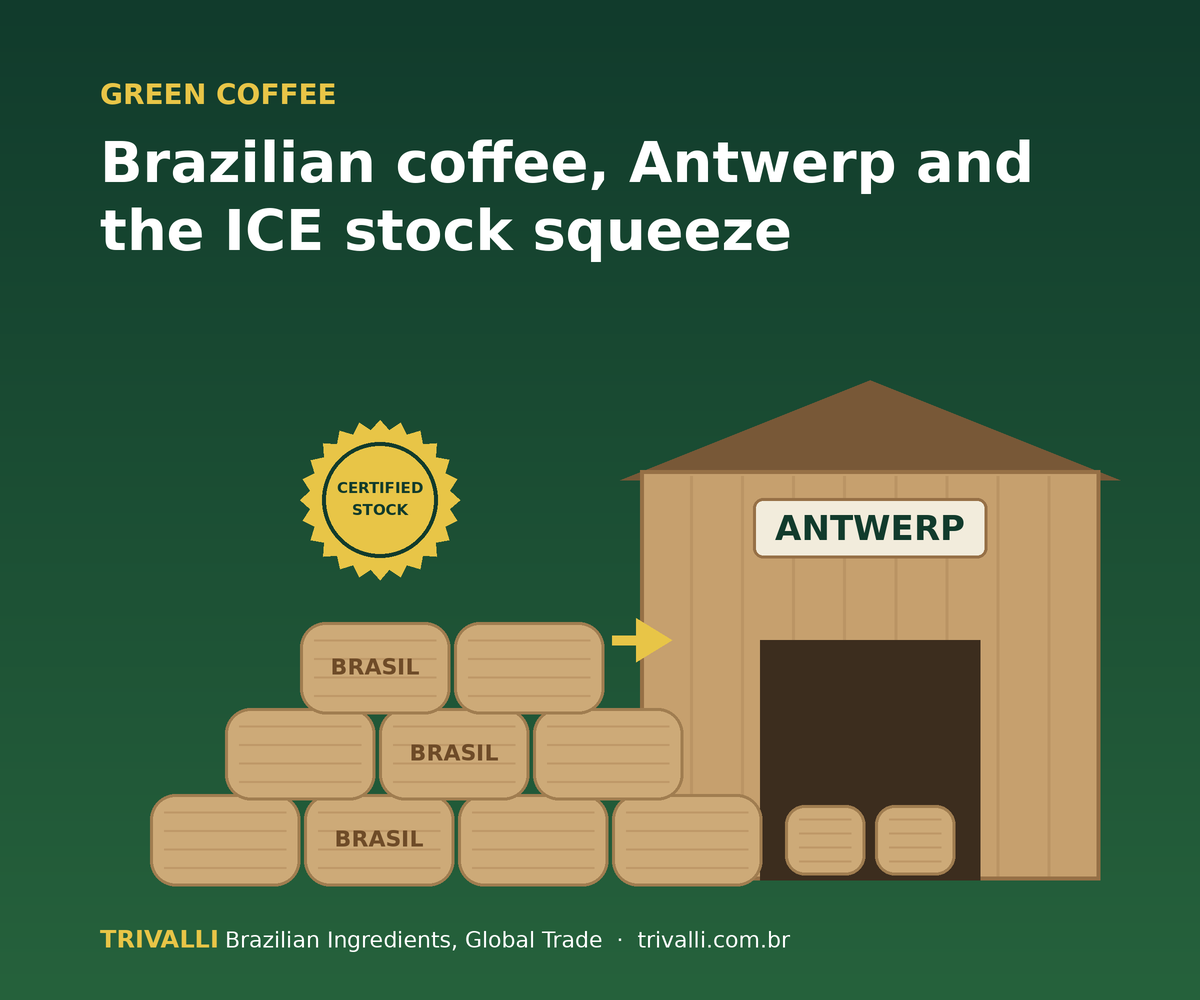
Most European roasters never take delivery of a single bag from an exchange warehouse. Yet the coffee sitting in a handful of licensed warehouses, most of them in Antwerp, has shaped arabica prices and availability for much of 2026. This year those stocks fell to their lowest level in more than a quarter of a century, and Brazilian coffee is now the main source refilling them. Here is how the system works, what has changed, and what it means for a buyer who sources physical arabica from Brazil.
Certified stocks are green coffee that has been sampled, graded and cup-tested by ICE Futures U.S. and accepted as deliverable against the Coffee "C" futures contract. Each lot is 37,500 pounds. Only exchange-licensed warehouses count, and the contract specification lists the delivery points and their differentials: New York and Virginia at par; New Orleans, Miami and Houston at a discount of 0.50 US cents per pound; and three European ports, Antwerp, Bremen/Hamburg and Barcelona, at a discount of 1.25 cents per pound.
Origin matters too. Washed arabica from Mexico, Central America, Peru and several African origins is deliverable at par, Colombia and Kenya at a premium, and Brazil at a discount of 600 points, or 6 cents per pound. Vietnam will join, also at a 600-point discount, from the May 2027 expiry. Because the "C" contract is a washed-arabica contract, the Brazilian coffee that reaches the exchange is semi-washed (pulped natural). ICE has said that samples with an unwashed flavour in the cup fail grading, so ordinary Brazilian naturals, which make up most of the crop, are not the coffee that ends up certified.
Since the EU Deforestation Regulation entered the picture, the three European delivery points carry an extra requirement. Under an ICE notice of May 2024, coffee submitted for grading in Antwerp, Bremen/Hamburg or Barcelona from 31 December 2024 must have validated due diligence information entered in the exchange's DDI system. Older stock without it is discounted, and for 2026 contract months the discount is 300 points plus 50 points for each calendar month from January 2026. In practice, newly certified coffee in Europe is coffee whose EUDR paperwork has already been checked.
Reuters reported in September 2026 that ICE certified arabica stocks had fallen below 220,000 bags, against a range of 1 million to 5 million bags from the mid-2000s until early 2022, and that about 70% of the remaining stock was held in Antwerp. Barchart recorded the low at 217,646 bags on 15 September, the lowest level since 1999. Analysts quoted by Reuters saw this scarcity of deliverable coffee as the main reason prices stayed high despite expectations of a large Brazilian crop.
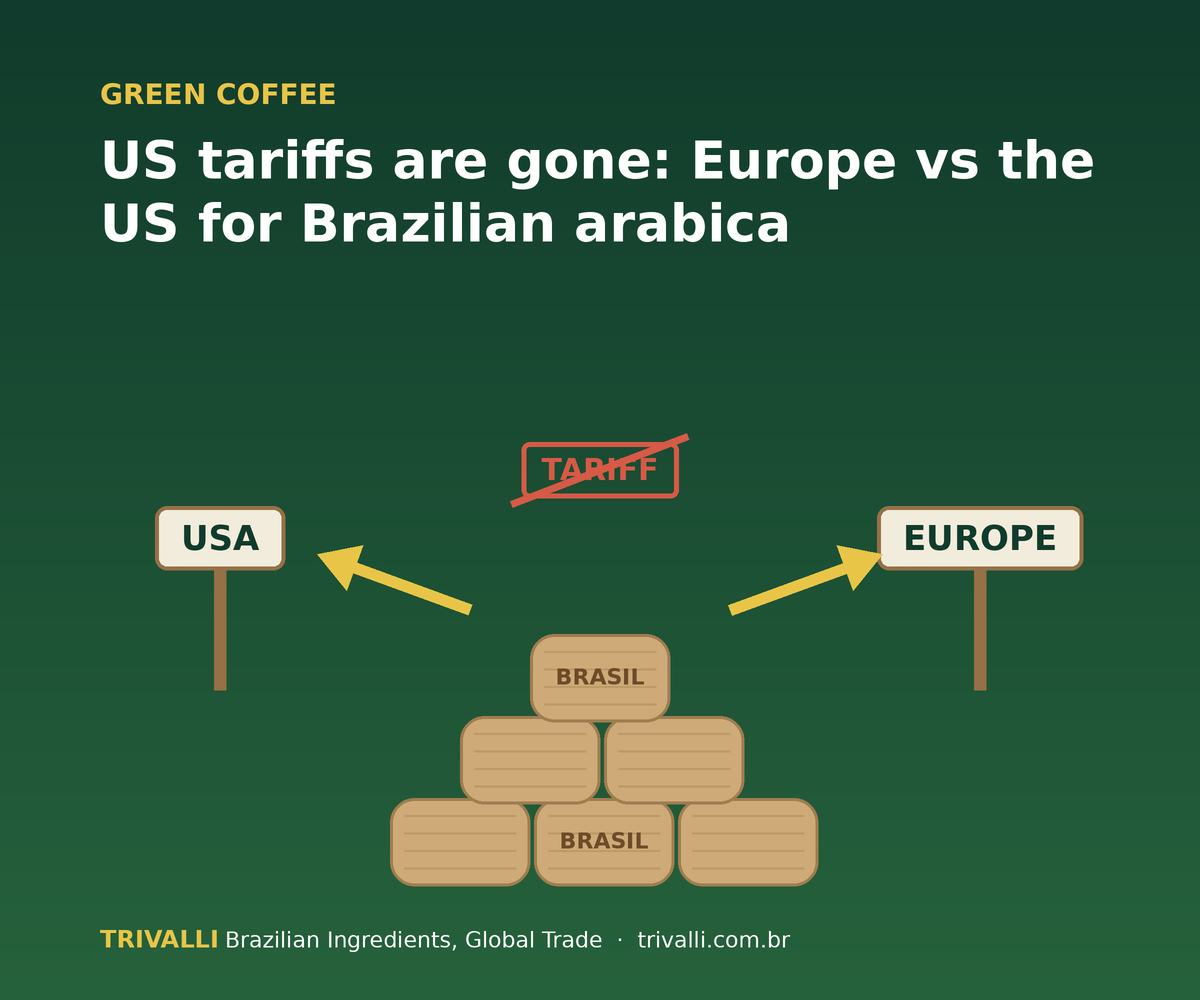
Stocks tend to fall when physical demand outruns new certifications. In 2025 and 2026, the US tariff on Brazilian coffee and a delayed harvest slowed the flow of Brazilian coffee to the exchange, while existing certified lots were taken out and roasted.
The rebuild started in the second half of 2026. Reuters reported in September that traders were planning significant deliveries of Brazilian arabica to ICE warehouses, with the potential to more than double certified stocks, and that more than 62,000 bags of Brazilian coffee had already arrived at exchange depots awaiting grading. The export data point the same way. Brazil's shipments to Belgium jumped 245.3% year on year in August, to 31,500 tonnes, and according to Cecafé figures published on 11 November, Belgium took 3.275 million bags from Brazil between January and October 2026, up 71% on a year earlier. That made Belgium Brazil's third-largest destination, behind the United States and Germany.
By early November the flow was visible in the exchange data. Trading Economics reported that ICE stocks of Brazilian coffee had risen to 103,457 bags on 9 November, a 14-month high, and that a further 104,370 Brazilian bags were awaiting grading on 10 November, the most in eight months. StoneX reported that in the week to 10 November certified stocks rose by 20,989 bags and coffee pending grading by 48,974 bags. Total certified stocks, at about 225,000 bags at the end of October, remained historically low.
Semi-washed Brazil has a second buyer. When origin differentials are low enough, exporters and trade houses can earn more by shipping semi-washed lots to Antwerp for certification than by selling them to a roaster. StoneX has noted that lower differentials at origin encourage certification. For a roaster that relies on semi-washed or fine-cup Brazil in its blends, that means competing with the exchange for the same lots during refill periods. Specifications and volumes agreed early with the exporter matter more than usual.
Antwerp is a physical hub, not just a price signal. Certified coffee is real coffee in a European port. Through deliveries against futures and exchanges for physicals, it moves into roasting plants, and Antwerp is also one of the main ports where trade houses hold green coffee for European customers. Buyers who are close to the port can sometimes cover short-term needs from warehouse stock while waiting for a shipment from Santos or Rio de Janeiro.
Pending is not certified. Coffee awaiting grading can fail on defects, screen size or cup. Market reports often treat pending bags as future supply, but a buyer planning cover should look at what has actually passed grading, and at how fast certified coffee is being withdrawn.
EUDR documentation is becoming the norm. The exchange's European delivery points already require validated due diligence information for new coffee. Physical buyers should expect the same standard from their Brazilian suppliers: farm geolocation, lot traceability from the warehouse at origin to the port, and documents that match the bill of lading. We covered the regulation's timetable in our article on what changes for importers on 30 December 2026.
Trivalli Comércio Global is a Brazilian exporter that can supply green arabica, from naturals to semi-washed lots, to European roasters and importers, with the traceability and EUDR documentation the market now expects. If you are planning your Brazilian coffee for 2027 or want an offer, please contact us through www.trivalli.com.