Brazil is not the first country a European buyer thinks of for apples. Chile, New Zealand and South Africa usually fill the gap between the end of European storage stocks and the new northern harvest. But 2026 has been an unusual year for Brazilian apples, and some European importers are taking a closer look.
After several seasons cut short by weather, Brazil harvested a large crop in 2025/26. In its October 2026 report, the USDA Foreign Agricultural Service puts production at 1.2 million tonnes, about 20% more than the previous season. Production is concentrated in the southern states, with Santa Catarina accounting for roughly 53% of the harvest and Rio Grande do Sul for 45%. Gala and Fuji account for about 60% and 40% of the crop respectively, and growers are adding newer strains such as Galaxy, Fuji Suprema and Pink Lady for better colour and storage performance.
Brazil has traditionally kept almost all of its apples at home: about 93% of fresh apples are sold on the domestic market. This year, with weak domestic demand and growers receiving roughly 30% less than in the previous season, exports became the outlet. Shipments rose about 180% year on year through August 2026. Brazil exported around 50,000 tonnes of apples in 2026, with India, Bangladesh and Saudi Arabia taking about 70% of the total.
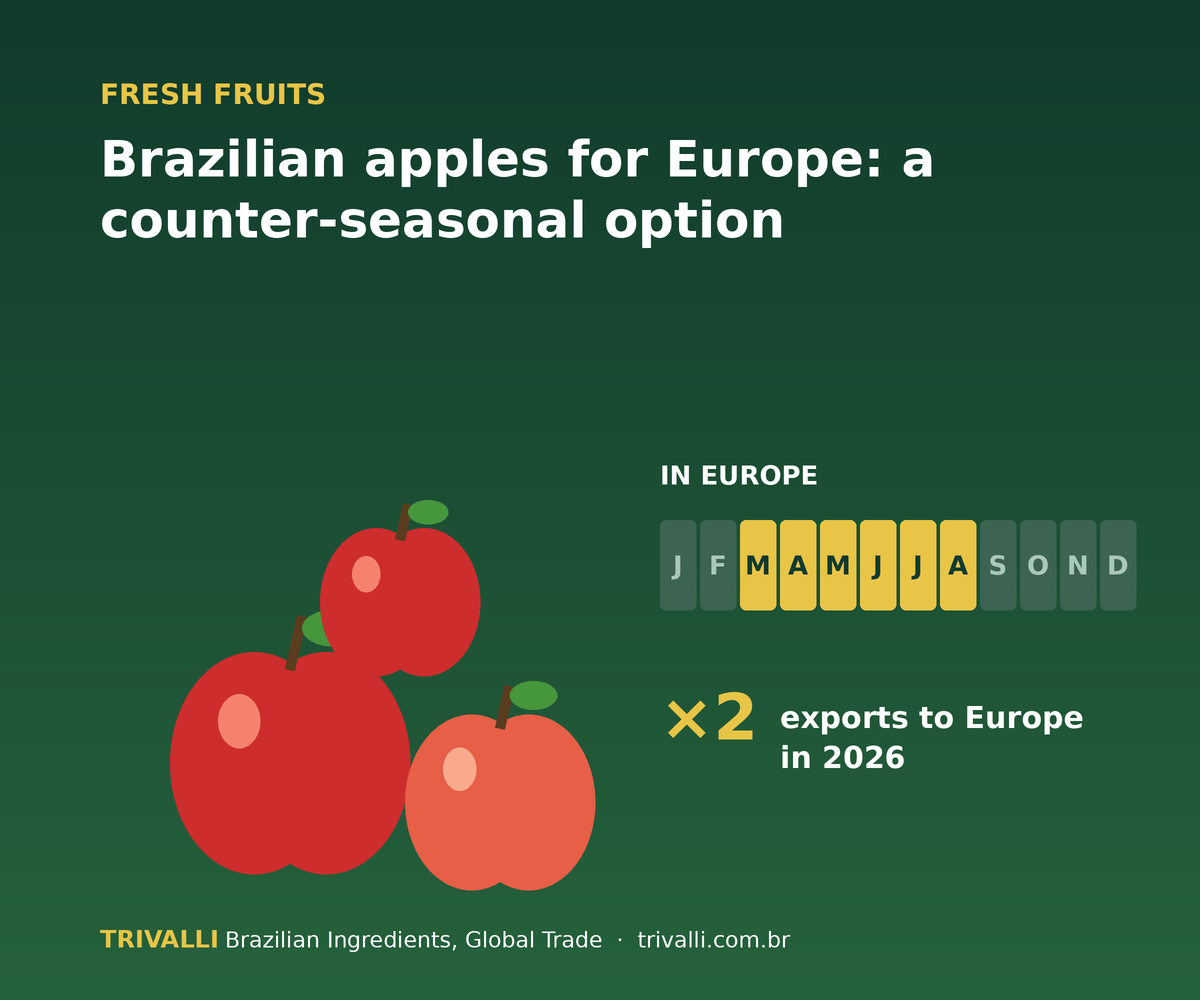
Europe is still a small destination, but it is growing quickly. In 2026 Brazilian apple exports to Europe rose by 104% in volume and 111% in value, from 7,300 to 14,940 tonnes and from US$7.5 million to US$15.8 million. Rio Grande do Sul supplied about 61% of that volume. Portugal, Ireland, the Netherlands and the UK are among the European destinations Brazilian exporters already serve.
Brazilian Gala harvest starts in January and Fuji follows from March to May. Fruit stored in controlled atmosphere is shipped over the following months, so Brazilian apples reach Europe mainly between March and August, the period when European storage stocks are running down and quality becomes harder to hold. For a European importer, Brazil is a way to add a fourth southern hemisphere origin to that window, with a transit time to North European ports that is comparable to Chile's.
The outlook for 2027 is also relevant. Industry sources in Brazil expect opportunities from a smaller European Gala crop, although rainfall during the Brazilian growing season could still affect the size of the next harvest.
The EU-Mercosur interim trade agreement has been applied provisionally since 1 May 2026, and some Brazilian fruits, such as table grapes, already enter the EU duty-free. Apples are on the slowest track. Under the agreement, the duty on Brazilian apples starts at around 10% and is phased out over ten years. The tariff gap with Chile and South Africa, which already have trade agreements with the EU, will therefore narrow gradually rather than disappear at once. Buyers should check the duty rate that applies in each year and the proof-of-origin rules required to claim the preference.
Brazil will not replace Chile or New Zealand on European shelves any time soon, and Brazilian growers still sell most of their fruit at home. But a larger crop, an export industry looking to diversify beyond South Asia and the Middle East, and a tariff that is now falling make Brazil worth a trial container for importers who want more options in the spring and summer window.
Trivalli Comércio Global supplies Brazilian fresh fruit to European importers, including Tahiti limes, mangoes, Hass avocados, table grapes and fresh ginger. If you are building a counter-seasonal programme and want to understand what Brazil can offer and when, please contact us through www.trivalli.com.