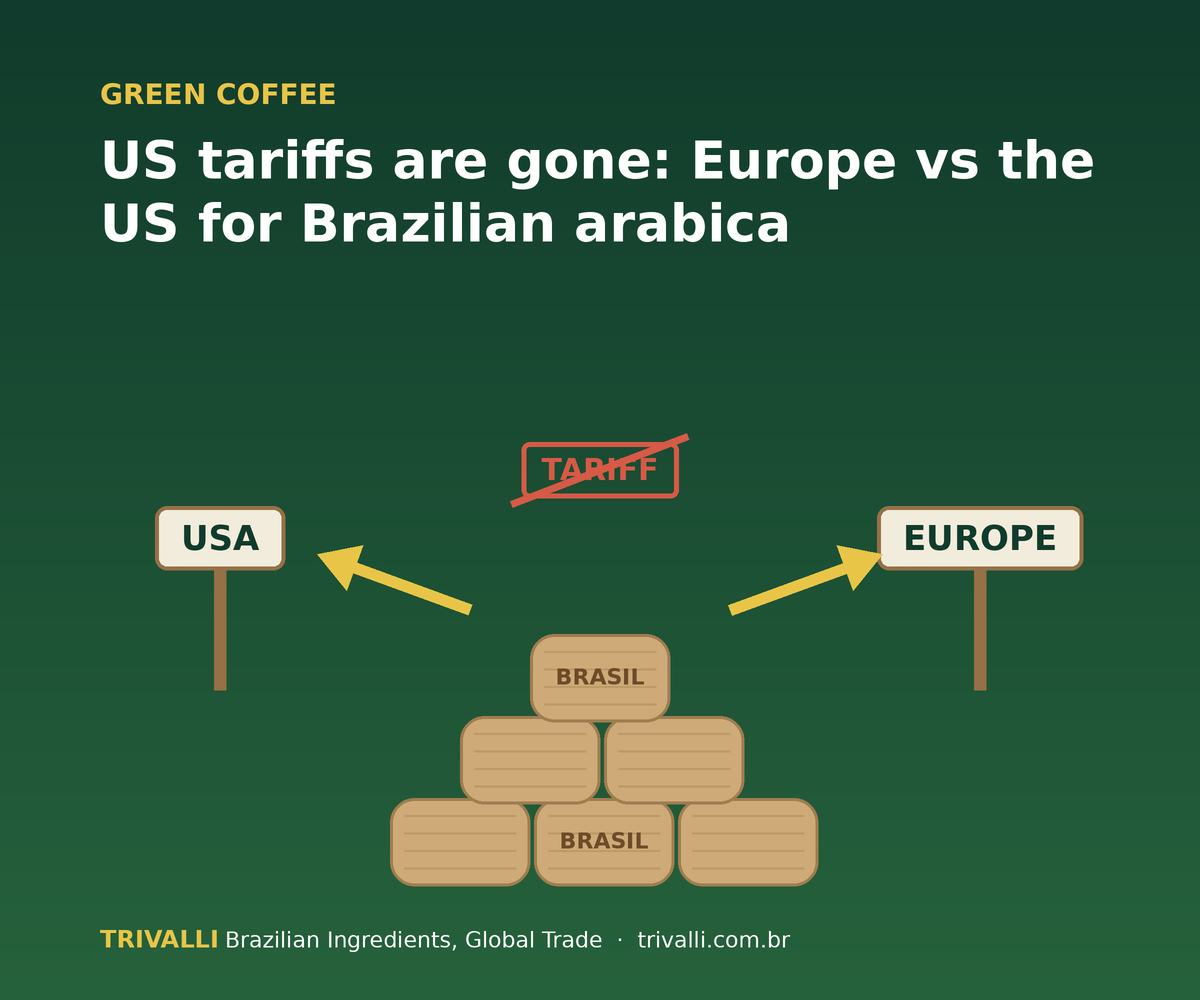
For a little over a year, European roasters had an unusual advantage in Brazil. The extra duties the United States placed on Brazilian goods in 2025 pushed American buyers away from the world's largest coffee origin, and Europe picked up the slack. Germany even became Brazil's biggest customer for a full crop year. Now the duties are gone and the Americans are back. This article looks at what has changed in the flows, where European and US buyers will compete, and what a European roaster can do to keep access to the Brazilian lots it needs. It does not discuss prices or contract terms, which we covered in our article on how European buyers contract the 2026/27 crop.
In August 2025 the United States added a 40% tariff on Brazilian products to the 10% already in place, so Brazilian green coffee entered the US with a 50% duty. The effect was immediate. According to Cecafé, Brazil shipped 1.315 million bags to the US between August and November 2025, against 2.917 million in the same months of 2024, a fall of 54.9%.
The duties were removed in stages. An executive order of 20 November 2025 eliminated the additional 40% on Brazilian green coffee, beef, cocoa and other agricultural products. Instant coffee stayed under pressure for longer, and in July 2026 Washington exempted Brazilian instant coffee from a 25% Section 301 tariff and kept Brazilian coffee out of a new round of duties announced later that month. Cecafé now describes the additional tariffs as fully withdrawn.
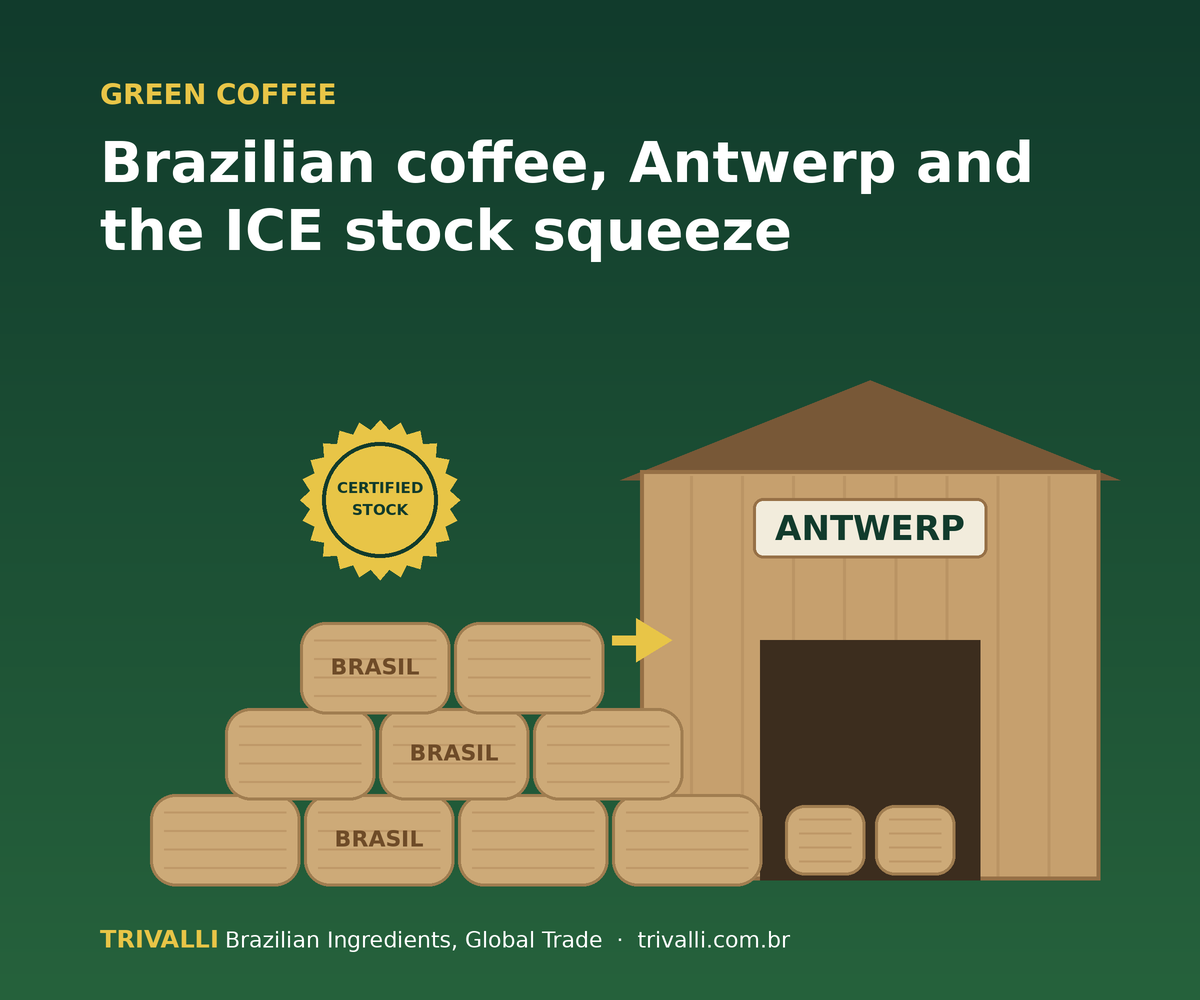
While US buyers stayed away, Europe took more. In the 2025/26 crop year (July to June), Germany imported 5.188 million bags of Brazilian coffee against 4.243 million for the United States, overtaking the US as Brazil's first destination for the first time since 2009/10. Belgium, the gateway to the Antwerp exchange warehouses, grew even faster: it took 3.275 million bags between January and October 2026, up 71%, and Italy took 3.049 million, up 13.5%. We explained the Antwerp side of this story in our article on ICE certified stocks.
The US came back quickly once the duties fell. Brazil exported 5.327 million bags in October 2026, the largest monthly volume since Cecafé's series began in 1990 and 28.4% more than a year earlier. Cecafé attributed the record to two drivers: the arrival of the new crop and the return of American buyers, with shipments to the US up 119% on October 2025. Over January to October the United States is again Brazil's largest customer, with 4.575 million bags, or 13.3% of the total. Germany follows with 3.812 million bags, 11.8% less than a year earlier.
The same shift shows in higher-quality coffee. Brazil exported 5.702 million bags of differentiated coffees (specialty and certified) from January to October 2026, 13.3% less than a year earlier. The United States bought 977,410 bags of them, 17.1% of the total, ahead of Germany, Belgium, Italy and the Netherlands.
Quality arabica, not volume. The 2026/27 Brazilian crop is large, and Conab has projected a record of 66.2 million bags. Commodity volume is not the bottleneck. But the mix of exports has moved towards conilon: arabica shipments fell 6.4% from January to October, to 24.9 million bags, or 72.2% of the total. The lots that both US and European roasters want, such as fine-cup naturals and pulped naturals from the Cerrado Mineiro, Sul de Minas and Mogiana, are where buyers from both sides of the Atlantic will meet.
Differentiated and certified coffee. The US is the largest buyer of Brazilian differentiated coffees, and that category shrank this year. Roasters who need Rainforest Alliance, 4C, organic or traceable single-farm lots will see more competition for a smaller pool.
Shipping windows. When US demand returns, exporters can redirect lots that were planned for Europe. One exporter told reporters after the November 2025 decision that a shipment planned for Germany would be diverted to the US. Port capacity at Santos, which handles most Brazilian coffee, has been tight, so container space and loading slots become part of the competition.
Relationships built during the gap. Many European buyers built direct relationships with Brazilian exporters and cooperatives while US demand was weak. Those relationships are now the main protection against diversion: an exporter that knows a buyer's profile, volumes and timing will plan lots for that buyer before the new crop is sold.
Trivalli Comércio Global is a Brazilian exporter that can supply green arabica and conilon to European roasters and importers, from Cerrado and Sul de Minas naturals to pulped naturals and certified lots, with the traceability and EUDR documentation the European market requires. If you are planning your Brazilian coffee for 2027, please contact us through www.trivalli.com.