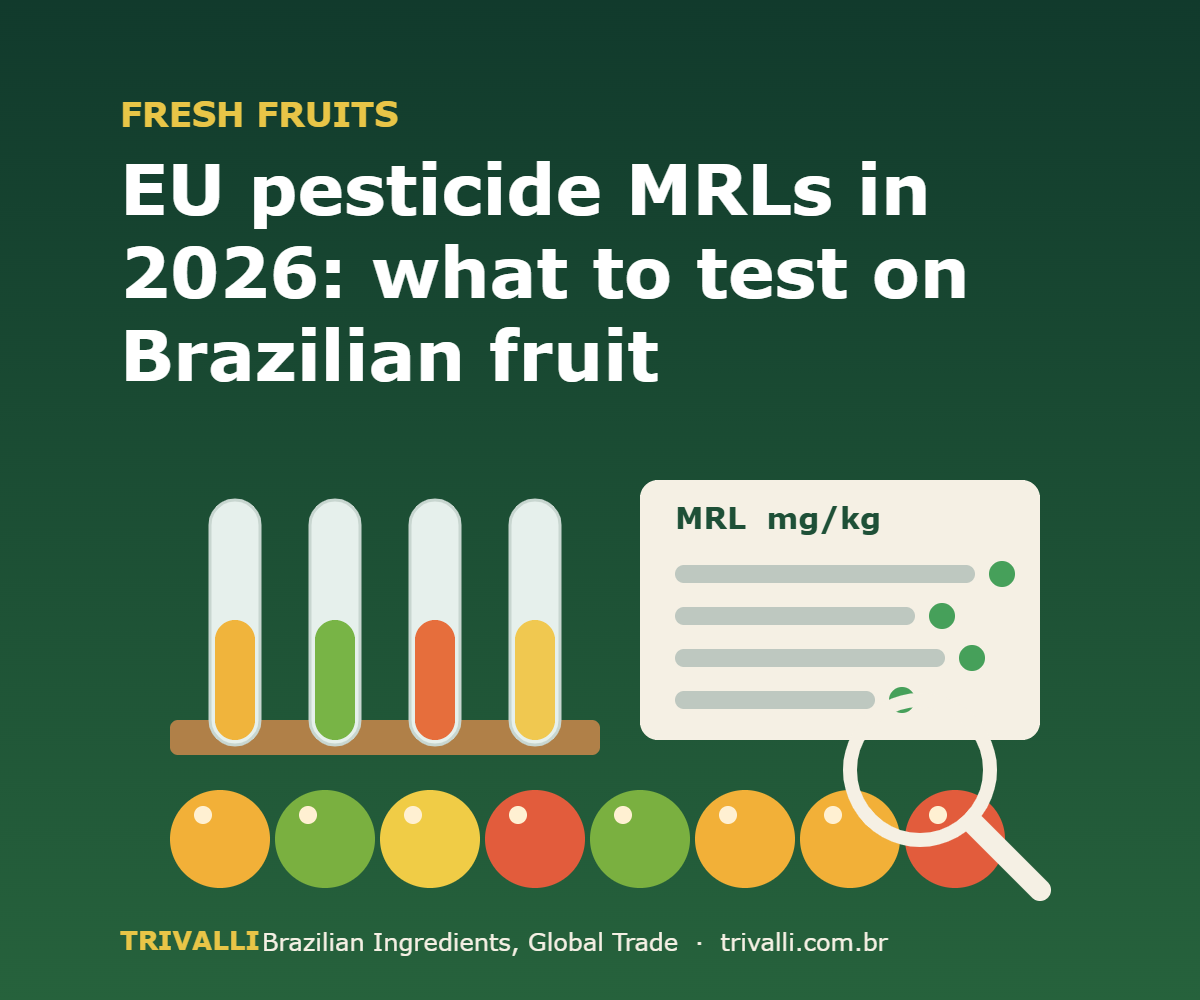
For a European importer of Brazilian mangoes, limes, papayas or avocados, a pesticide residue problem rarely announces itself early. It shows up as a held consignment, a retailer rejection or a withdrawal. Between 2025 and 2027 several rule changes touch tropical fruit directly. Below: what changed, how enforcement reads a lab result, and a testing routine that keeps surprises to a minimum.
Maximum residue levels (MRLs) are harmonised across the EU under Regulation (EC) No 396/2005. Every combination of active substance and product has a limit; where no specific limit exists, a default of 0.01 mg/kg applies, which in practice is the analytical limit of determination. Substances that are not approved in the EU are not automatically banned in imports, but their limits tend to sit at that floor unless an import tolerance has been granted on the basis of a dossier showing approved use in the exporting country and an acceptable consumer risk.
The working reference is the Commission's EU Pesticides Database, which lists current and historical MRLs by product and residue. The Commission notes that it is for information only; the binding text is the one in the Official Journal.
Two consequences follow. A substance legally registered for a crop in Brazil can still be a problem in Europe if the EU limit sits at the floor. And limits change on fixed dates, so last season's compliant spray programme may not be compliant this season.
According to COLEAD's yearly review, published in June 2026, EU MRLs changed for 38 plant protection substances in 2025. Three groups deserve attention.
Commission Regulation (EU) 2023/334 lowered the MRLs for these two neonicotinoids, and the new limits have applied since 7 March 2026, a 36-month delay after publication, as USDA's Foreign Agricultural Service reported. The justification was environmental, the protection of pollinators, rather than consumer health. AGRINFO lists mangoes, avocados and citrus, including limes, among the products affected. In practice, residues of either substance in these fruits should now be essentially absent.
Commission Regulation (EU) 2025/158 reduced the MRLs for acetamiprid on a range of products, with bananas among those named by AGRINFO; the new limits have applied since 19 August 2025. It belongs on any screening list for imported fruit.
This is the change to plan for now. Commission Regulation (EU) 2026/1546, published in the Official Journal on 9 July 2026, removes all specific MRLs for carbendazim and thiophanate-methyl and replaces them with default values at the limit of determination, 0.01 mg/kg for fruit. It applies from 29 January 2027.
The detail that matters most is the transitional rule. Products placed on the EU market before that date can normally continue to be sold under the old limits, but the regulation excludes several fruits from that grace period: carbendazim in grapefruits, oranges, papayas and mangoes, and thiophanate-methyl in the same fruits plus mandarins. In other words, mangoes and papayas still in the chain on 29 January 2027 must meet the new limits, even if they were compliant when they arrived. With weeks of sea freight, fruit packed in December 2026 already falls inside that window.
EFSA's report on 2024 data, released on 5 May 2026, for the first time separated import controls from national monitoring. Of 39,433 samples taken under import controls, about 5.5% exceeded an MRL and 3.6% were non-compliant once measurement uncertainty was taken into account. EFSA notes that consignments are held at the border until results are available and enter the market only if they comply. Non-compliance in the EU-coordinated and national programmes was lower, at 1.2% and 1.8%.
A separate regime, Implementing Regulation (EU) 2019/1793, sets temporarily increased checks for specific product and origin combinations. In the version that applied from 12 August 2025 (Implementing Regulation (EU) 2025/1441), the only Brazilian entry was black pepper, listed for Salmonella rather than pesticides, and no Brazilian fresh fruit appeared. ChemLinked reported that Regulation (EU) 2026/194, applicable from 18 February 2026, lowered the check frequency for Brazilian black pepper. The list was revised again from 30 June 2026 by Regulation (EU) 2026/1206, so check the current consolidated text before each season.
Official laboratories follow the Commission's guidance document SANTE/11312/2021, whose latest version (v2026) has applied since 1 January 2026. It sets a default expanded measurement uncertainty of 50%, and a sample is treated as non-compliant only when the result minus that uncertainty still exceeds the MRL. The same document links official residue testing to ISO/IEC 17025 accreditation.
That margin covers lab variability; it is not a buffer to plan around. A result just above the MRL may pass an official check and still fail a retailer specification. Treat any result above the MRL as a problem to solve before loading.
Trivalli Comércio Global is a Brazilian exporter that can supply mango, Tahiti lime, avocado and other fresh produce to European buyers. We are happy to discuss residue requirements, testing scope and contract terms before the first shipment. Contact us via www.trivalli.com.br.